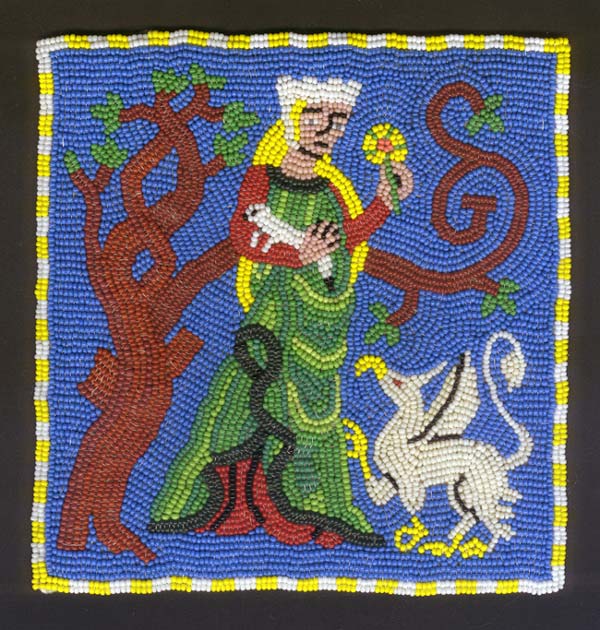
Tools of the Trade

beading-tools1-600x600

Thread:
First off I can’t say enough about using the right thread. That said, Coast and Clark, while being a FINE machine thread, has no place in a bead tool box. It simply can’t handle being drug through glass over and over. Glass beads while they may appear smooth, have microscopic teeth almost, the poly/cotton simply can’t handle it.

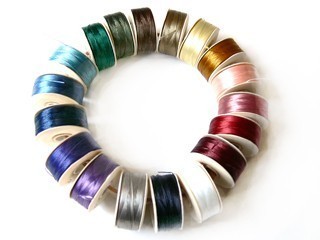
For woven work, try to use only 100%nylon NYMO brand style beading thread, which come in copious colors and thicknesses.
il_570xN.45332259

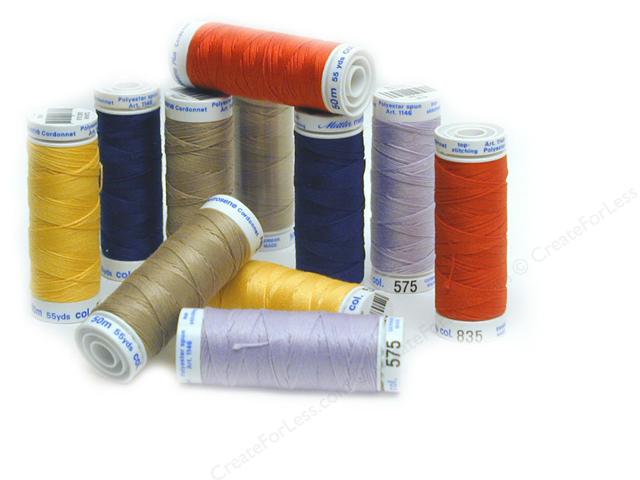
For fabric based work, use the more expensive sewing thread in your local fabric shop, those european ones of 100% long grain polyester (my preference if doing fabric based beadwork).
15333-3-2

They usually price at $4 or less for a under 200 yards. The brand I use is  Mettler Metrosene. The 100% poly stuff last SOOOO much longer, you’ll thank me later. Trust me, I’ve had Coats and Clark break after three stitches, I’m trying to teach you to not make my mistakes.

I very rarely break or fray using them like I did when I used Coats & Clark.The thread goes a long way so just bite down and buy it, it’ll last years, and most times you can use it to the end of the string.

Thread Conditioner:
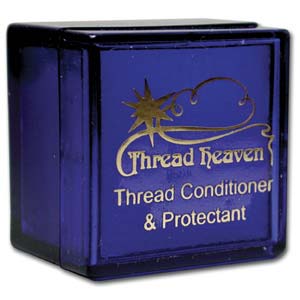
Traditionally beeswax was used for bead threads, but it’s the modern day and there are better alternatives. Beeswax is heavy and it will gunk up fine fabric, maker thread tacky and stiff, clog teeny bead needle eyes and bead holes. Instead, use something called “thread heaven”, available at any sewing store. It’s a silicone soft wax type material but leaves thread supple an silky and won’t leave a nasty residue in your needles.
thread-heaven-thread-conditioner-504-p

Hardwood ruler:
Never eyeball a straight line, sometimes pulling the fabric as you have to will skew straight lines, keep redrawing it with a stiff ruler. I use a six inch as it fits better in my box.

unfinished_wood_ruler_1

Mechanical Pencil:
ALWAYS use pencil, never ever use a pen, it can and will most probably bleed.

20603-7005-1-2ww-m

In time if you can draw it with a mechanical pencil, taking in to coinsideration bead widths, then you can bead it.The eraser also works somewhat on cloth if the mark is light enough.

If you have colored cloth use a colored pencil, so it will wash out.

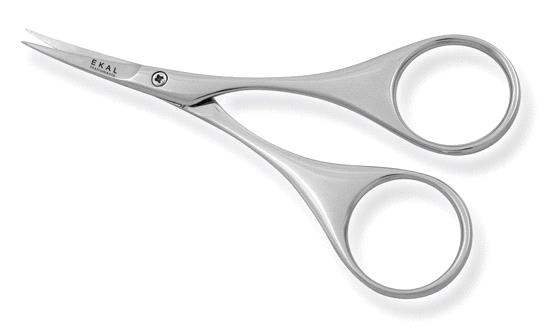
Fine tip scissors:
If you say really change you mind on a finished section that is partially or even totally secured down, do not despair, just hold the scissors against the cloth and clip across it, under the beads like you were trimming hedges. It will cut the securing threads, and keep your lacing stitchs intact, and you can literally peel off the beads like a bandaid. It’s cool. DONT use a Seam Ripper unlless your a VERY sure hand, one false move and you’ll cut the fabric as well as the thread.
Pakistan_Fancy_and_Embroidery_Scissors_Beauty_Scissors200911261751337

Thimble and rubber needle puller:
ThimbleSometimes pulling a needle through can be tough, hole sizes can vary. Both these help, put you thumb over the bead in question HARD and pull or push the needle through. Putting pressure on the bead seems to help keep the bead from cracking, if it does, don’t despair, tack down the thread that went through and then out a new one in and then quickly lace it to the beads to either side.

6a00d8341c5dea53ef00e54f1cdf6a8833-640wi
41O5oed4njL

Needles:
Well duh! But unlike my thread rant, I DO prefer coats & Clark bead needles (they have a yellow package). But, I am not sure they are even made anymore, luckily I have a old collection of the I’m still working through.

Needles__28050.1405421952.1280.1280

Otherwise your real only other choices are British needles, while highly acclaimed seem to be more brittle, at least to me. I once used a pack of 20 on ONE medallion . They just kept snapping. But if you DO want to buy Brit needles, I like PONY over JOHN JAMES.I like them best because they BEND, and don’t break, and that’s a GOOD thing. Always save the bent needles, they come in handy and are ofttimes more comfortable and easier to use.

shoppingshopping-1A pack of 20 of either comes in a little envelope and go for about $5, much cheaper than buying 4 in a pack in the long run.

More often then not you will lose needles by breakage at the eye. I often pitch them for losing plating. Loss of plating can damage delicate fabrics and cut thin threads, so don’t use a damaged needle.

Cheat Sheet: German Terminology

Here are some basic terms you will encounter in German art books or plate listings. If you can pick out at least these terms you should have the basics.

Materials

Textil/Textilen – Textile/Textiles
Seide = Silk
Leinen – Linen
Wolle = Wool
Baumwolle = Cotton
Metall = Metal
Edelmetall = Precious Metal
Silber = Silver
Geld/Gold = Gold
Holz = Wood (as in made of, a “wooden” object)
Baum = Tree
Korallen = Coral
Email, Emaille = Enamel
Kette = Chain
Bein = Bone
Elfenbein = Elephant Ivory
Glas = Glass
Kristall = Crystal (Glass)
Bergkristall = Crystal (Quartz)

Perle/Perlen = synonymous for beads and pearls of all kinds.
Glasperlen = specifically beads made of glass
Flußperlen = “Water perles”/Freshwater Pearls. Only seen occassionally.

Schmuck = many meanings… jewelry, ornament, embellishment, trinket… sparklies!

Schmuckbrakteaten = decorative coinlike discs, usually gold. These are a thin stamped highly detailed and decorative gold discs of foil usually sewn onto altar hangings or liturgical ceremonial wear. Sometimes seen applied to paintings as well. Usually seems to be interchangable with Plättchen. The same as us calling the fake round shiny metal things on belly dance scarves “coins”. They look like them, sorta, but aren’t.

Plättchen = discs or plates (known as bezants in sca)
Goldplattchen = Gold discs (known as bezants in sca)

Stäbchen = Sticks, also refers both to knitting and crochet needles as well as chopsticks, and bugle-shaped beads.

Item Terminology

Stickerei = Embroidery
Perlenstickerei = Beaded Embroidery
Gestickt = Embroidered
Gewebt = Woven
Reliquien, Reliquiare = Reliquary
Ziborium = Container for the Holy Host (Communion wafer)

Farben = Color, coloring

Colors:
Rot = Red
Gelb = yellow
Grün = Green
Blau = Blue
Purpur = purple
Schwarz = Black
Weiß = White

Musuem, Art and Location terms

Kunst = Art
Künstler = Artist

Sammlungen, Sammlung = Collection
Museumsführer = Musuem Guide (brochure)
Ausstellungen = Exhibitions
Ausstellungskatalog = Exhibitions Catalog
Landesmuseum = State Museum
Orte = Places, location
Stadt = City, municipality
Staat, Staaten = State (region/province)
Öffentliche = Public, as in publically owned or operated.
Halböffentlich, Halböffentlicher = Semi-public
Privatbesitz = Private Hands (Private Collection/Collector)

Historisches = Historical
Geschichte = History
Kunstgewerbe = Arts and crafts, applied arts
Sonstiges = Miscellaneous, assorted, various

Kirche/Kirchen = Church (Parish)
Dom = Cathedral
Dommuseum = Cathedral Musuem
Domschatz = Cathedral Treasure
Kunstschatz = Art Treasure
Schatz = Treasury

Kloster = Monastery, friary, cloistered religious order (singular)
Klöster = Monasteries, friaries, cloistered religious orders (plural)
Frauenkloster = Convent, nunnery (singular)
Frauenklöster = Convents, nunneries (plural

Time and Numbers

Jahr/Jahren = Year/Years
Abbreviated is “j”
Useage: 1635 jahren or jahr 1478

Jahrhundert – Century
Abbreviated is “jh”
Useage: 16. jahrhundert is 16th century – not 1600′s.

Centuries are always in numerals, followed by a dot (example “14. Jh”). They are never spelled out as we do in English, like the words “fourteen” or “fourteenth”.

Handwritten number 1′s can look like a ^ possibly dotted as a letter “i” would be, so they can be very confusing on some handwritten records if you don’t know what you are looking at.

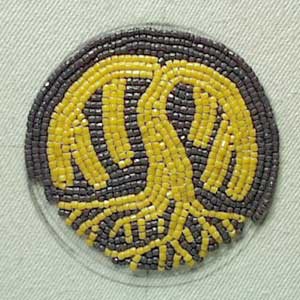
12th Century: Pearled Cushion

Pearled Cushion, Germany
Assuming 12th Century

372361343_4ed72d8d55_o

12th Century Byzantine pearled decorative circle

372361155_1af5e3c974_o

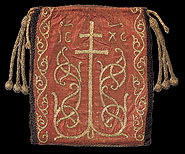
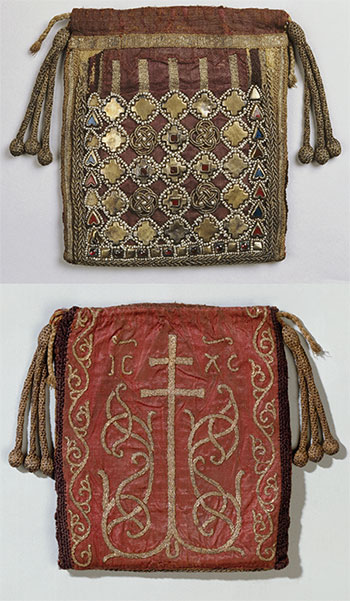
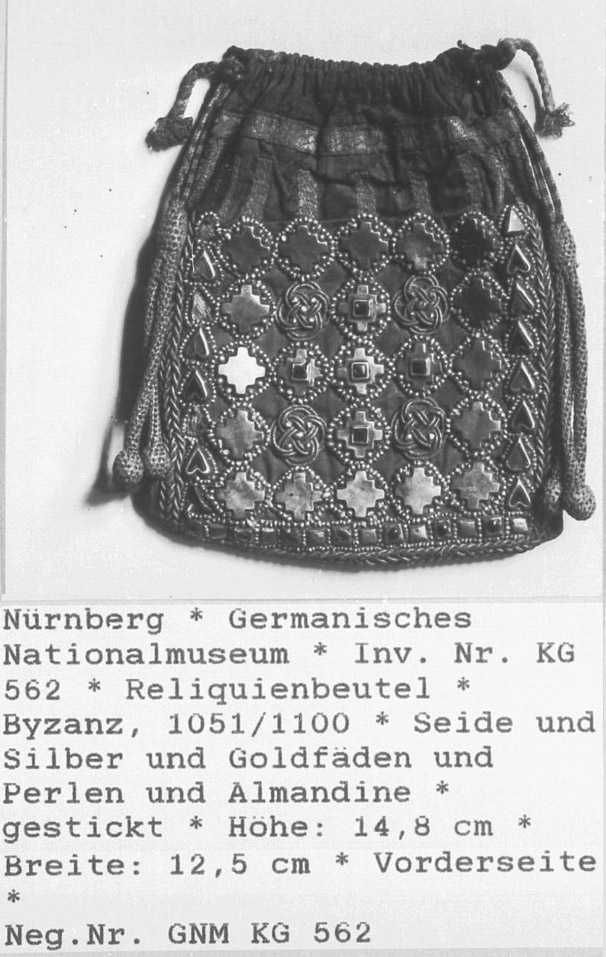
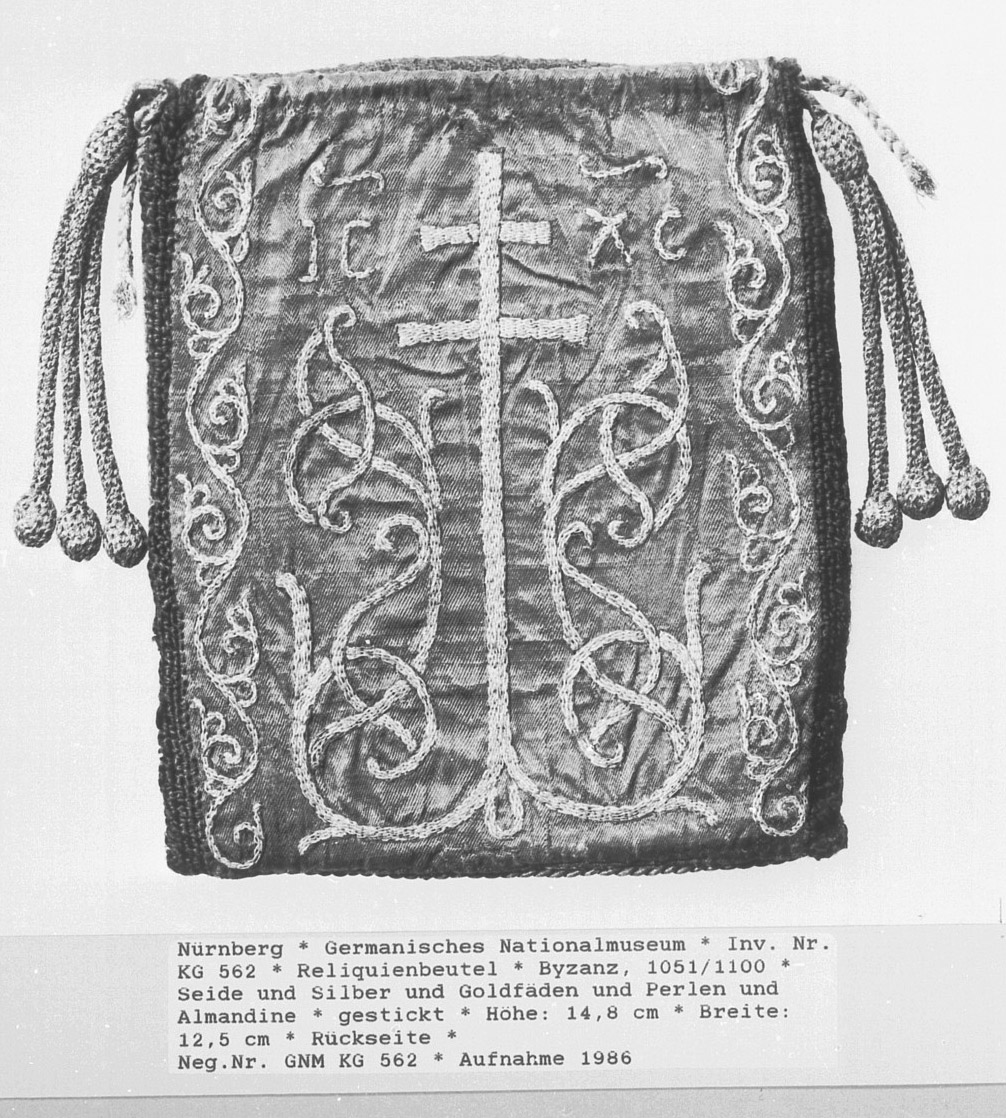
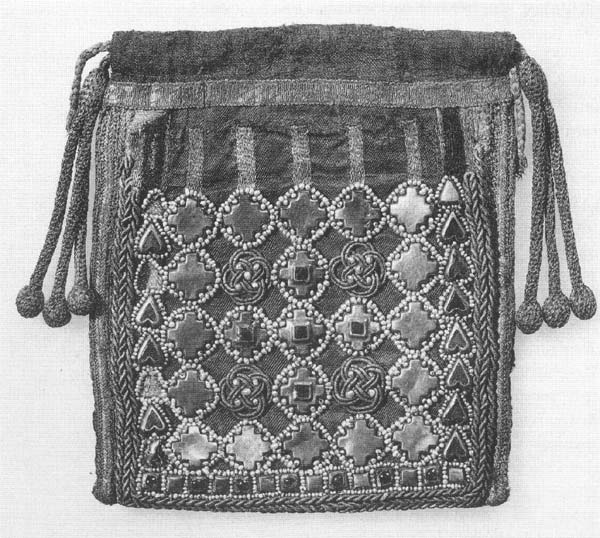
11th Century: Reliquary Bag with plaques and pearls


Reliquienbeutel, Trier, around 993

IN GERMAN: “Beutel für eine Kreuzreliquie, Vorderseite, Stickerei mit Perlen, vergoldeten Appliken und Spiralknoten. Trier, nm 993. Nürnberg, Germanisches Nationalmuseum (KG 562)
Auch noch aus dem späten 10.Jahrhundert stammt der mit bunter Seide in Ketten-, Stiel- und versetztem Flachstich auf Leinen gestickte Alexanderflug in Würzburg, der dort lange mit der großen bemalten seidenen Kiliansfahne verbunden gewesen ist.

Der wohl von Anfang an für Hildesheim bestimmte, wahrscheinlich aber noch in Trier um 993 gearbeitete Beutel für eine Kreuzreliquie in Germanischen Nationalmuseum, Nürnburg, ist aus rotem, ungermustertem Samit. Auf seiner Vorderseite wirkt die Aufnäharbeit mit Perlenkränzen um vergoldete Appliken in Kreuz- und Herzform, teilweise mit eingelassenen Glasflüssen, rot gefärbtem Bernstein oder gefaßten Almandinen sowie mit vier Goldspiralknoten wie Goldschmiedewerk, während auf der Rückseite Goldfäden in versenkter Anlegetechnik verarbeitet sind.


IN ENGLISH
(translated via internet):

Bags for a Kreuzreliquie, front, embroidery with beads, gilded Appliken and spiral knots. Trier, Nm 993. Nuernberg, Germanic national museum (kg of 562) Also still from the late 10. century originates the Alexanderflug in peppering castle, gestickte with multicolored silk in chains -, handle and transferred flat pass on linen, which was connected for a long time with the large painted be-being those Kiliansfahne there.

Probably from the outset for Hildesheim the determined, probably however still in Trier around 993 bags worked for a Kreuzreliquie in Germanic national museum, Nuernburg, is from red, ungermustertem Samit. Its front the sewing on work with bead rings affects around gilded Appliken in cross and heart form, partly with let in glass rivers, red colored amber or calm Almandinen as well as with four gold spiral knots such as gold forging work, while on the back gold threads are finished in sunk putting on technology.

Bag for a cross relic, front, embroidery with pearls, gilded Appliken and Spiralknoten. Trier, nm 993rd Nuremberg, germanic national museum (KG 562)
Also yet out of the late 10. century the Alexanderflug embroidered with colorful silk in chains, handle and staggered flat sting on lines in Würzburg, that comes painted been is there long with the large silk Kiliansfahne connected.

That probably from the beginning for Hildesheim determined, probably however yet in Trier around 993 worked bags for a cross relic in germanic national museums, Nürnburg, is out of red, ungermustertem Samit. On its front, the Aufnäharbeit with pearl wreaths influences gilded around Appliken in Kreuz- and heart form, partial with admitted glass rivers, red colored amber or calm Almandinen as well as with four Goldspiralknoten as well as gold smith work, during the back gold threads in sunk designed technology processed are.

Thanks to Roxelana Bramante for her typing this for me.

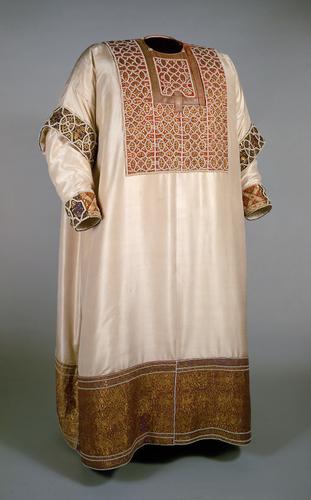
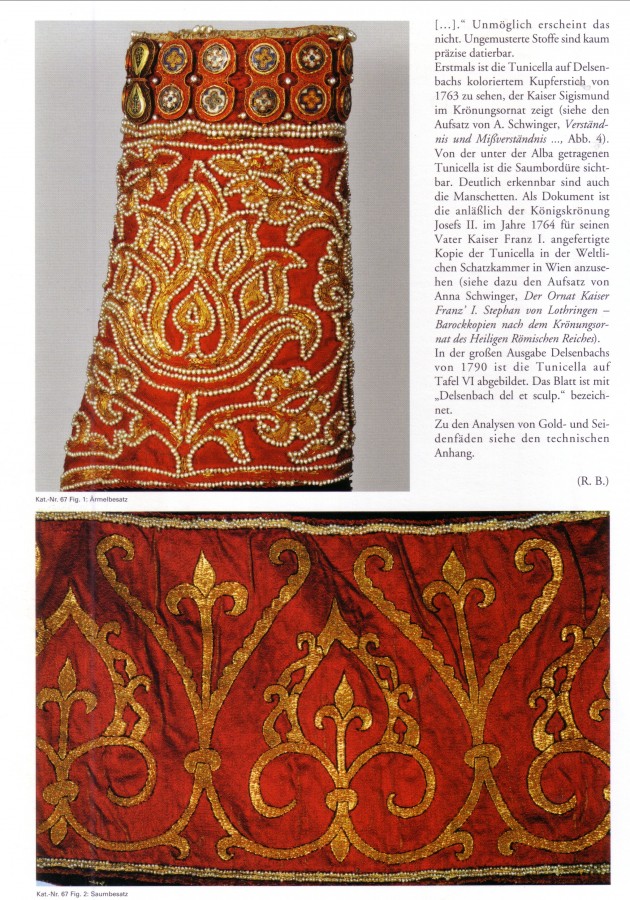
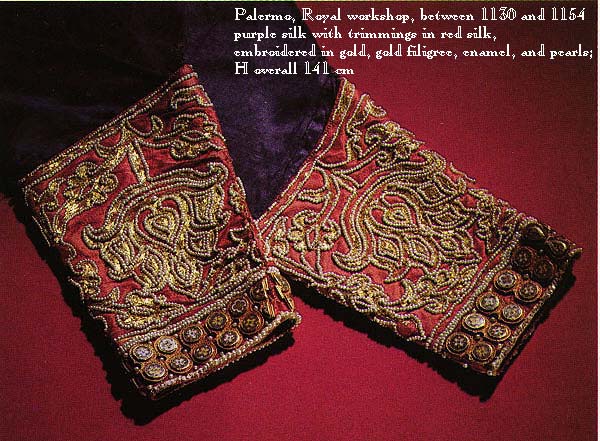
12th Century: Roger II Dalmatic

DALMATIC , PART OF THE INSIGNIA OF THE HOLY ROMAN EMPIRE
Sicily, Palermo, Royal Workshop, 1130 – 1140, Period of King Roger II.
Viuenna, Weltliche Schatzkammer
Cuff: 21 cm wide.
Lower border: 21 cm wide

The robe has the shape of a tunicella with a narrow upper part, long sleeves that taper towards the edge and a skirt that expands towards the hem with side gussets.
Both the blue – with madder and Waid dyed – unbleached base fabric as well as the red, patterned trim of the hem and the cuffs is Samit (scratched silk). Above and below, the wide hem border is bounded by double pearl cords. Gold embroidery in sunk planting technique adorns this border with lilies and palmette shapes. The technical implementation of the embroidery is so close to that of the coronation mantle that one can assume a simultaneous emergence.
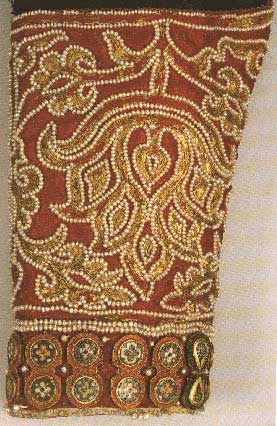
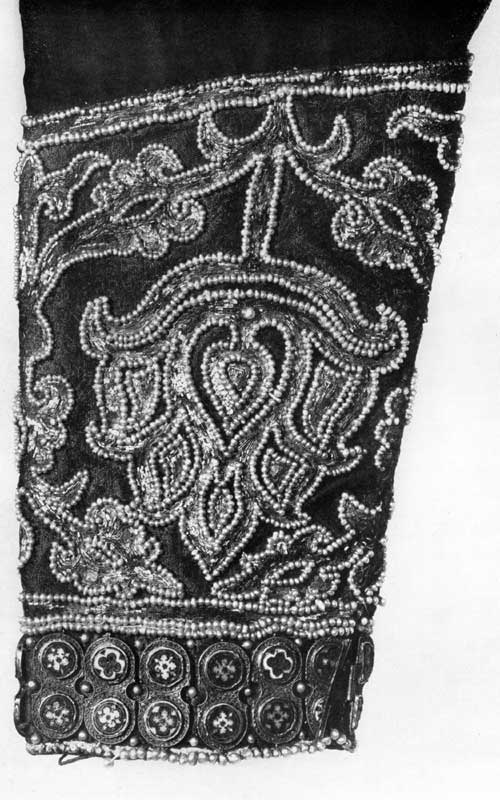
A special feature is the embroidery of the cuffs: pearl strings framing palmette motifs whose inner surfaces are filled with gold tubes, which were flattened after sewing. This technique is, as far as we know, unique. The lower edge of the cuffs are decorated with violin-shaped, densely juxtaposed appliqués with gathered cellular enamel, which are stylistically and technically so similar to the mounts on the coronation mantle that there is no doubt about a connection between the two garments.

The neckline of the robe is covered with a 3 cm wide Brettchenborte, which is contoured by means of individually sewn beads. This border is the same as it was sewed on the Alba.
For the first time clearly identifiable the robe appears as a “blue skirt” in a document of the year 1350, with the transfer of the treasury to Charles IV is confirmed, but may well in the mention of a “Rock of Samit” in the inventory of 1246 also already recognize the tunicella.
The tunicella was worn at the coronation under the Alba

Text From: http://www.khm.at/de/objektdb/detail/100470/

The dalmatic is of deep purple silk. The apparles illustrated, however, – a cuff and the lower border – are made of a silk material resembling that of the Coronation Mantle. The gold thread is underside couched, but on the cuff the gold is in the form of minute tubes with the couching thread passed through them. Pearls, gold plaques, enamels and filigree work. According to Fillitz the garment may belong to the same set of vestments as the Coronation Mantle.

Lit.: H. Fillitz, Die Insignien und Kleinodien des Heiligen Romischen Reiches. Vienna-Munich 1954, p. 58, Figs. 27, 28 – P. E. Schramm and F. Mutherich, Denkmale der deutschen Kinige und Kaiser, Munich 1962, p. 182, No. 181

Source: Schuette, Marie and Sigrid Muller-Christensen: Pictorial History of Embroidery ; NY: Frederick Praeger, 1964.

Deep Purple Silk Dalmatic of 1130-40
Cuff detail of the deep purple silk dalmatic of 1130-40 from the insignia of the Holy Roman Empire. It is a product of the royal workshops of Roger II in Palermo. Minute golden tubes fill the pearl motifs whilst the sumptuous effect is increased by the use of large coloured enamel motifs.

From: “Medieval Craftsmen: Embroiderers,” by Kay Staniland, University of Toronto Press, 1991, p. 46. ISBN: 0-8020-6915-0

START HERE – READ ME!

Favor panel done 131637033

When I started this over 15 years ago, and I was told beadwork “wasn’t period” in the medieval time period. Well, as you will see from the sources I’ve proven that it is since and I don’t hear that argument to much anymore. I wanted to make sure others didn’t either. That’s why I created this site – which I’m currently working on remodeling.

You can find the old site here in the mean time…. http://old.medievalbeads.com

My old pictures from the site, as well as my personal pictures from museums, are also currently organized on my flickr at: https://www.flickr.com/photos/verybigjen/collections/72157594588174008/

I also have newer finds and newer found better pictures on my pinterest that will  be added here: http://www.pinterest.com/jensegrest/medieval-beads/

If you see anything here that can help you in your studies, your documentation or your teaching, please take it,but please provide links and credits back to this site so then others can examine this field more in depth (and see them in full-color where possible).

See something I am missing information on? Something I don’t have at all? Email me